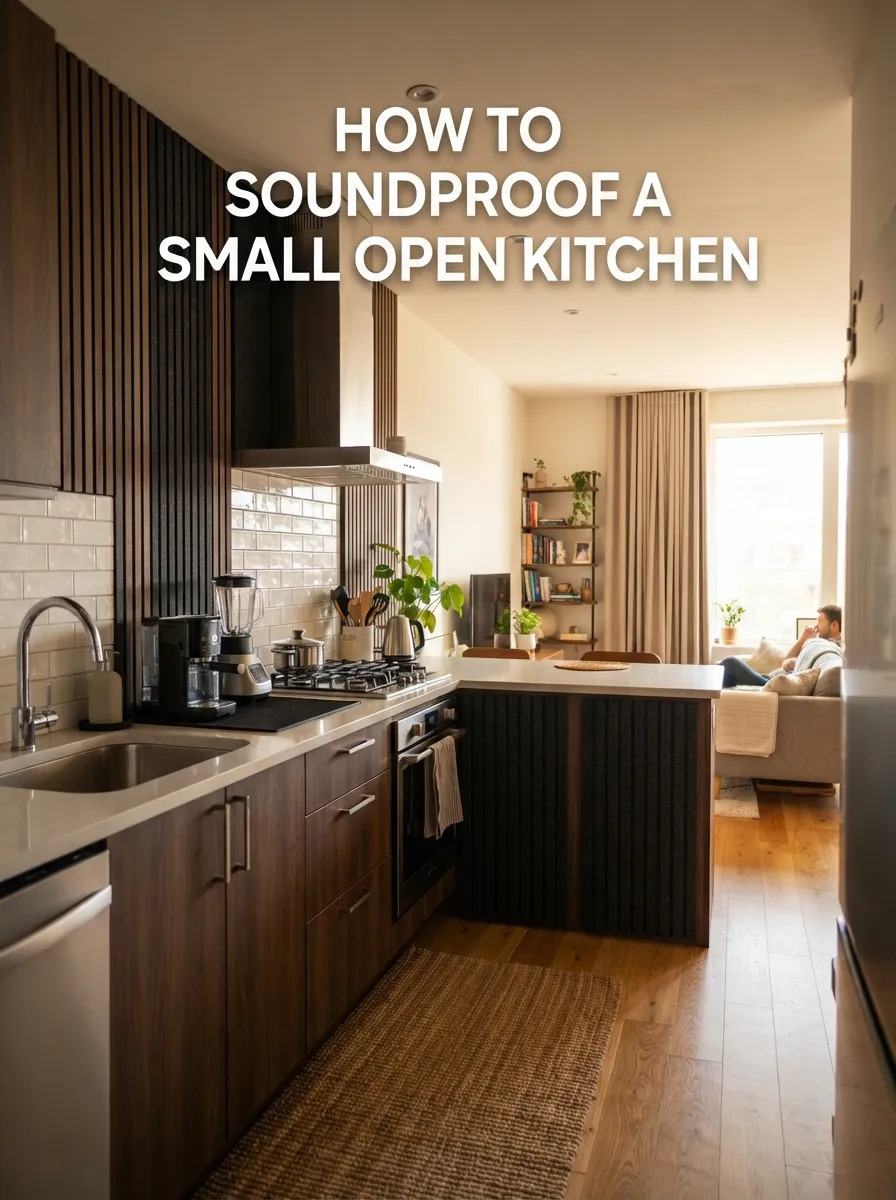
How to Soundproof a Small Open Kitchen

Soundproofing an open kitchen is a different problem than simply reducing echo — it’s about stopping sound from traveling out of the kitchen zone entirely, whether that’s into a nearby bedroom, a home office on a video call, or a living room during movie night. Here’s how to soundproof a small open kitchen using mass, sealing, appliance isolation, and a few structural options, going beyond soft materials into genuine sound blocking.
🚧 Quick Takeaways
- Soundproofing blocks sound transmission; acoustic treatment absorbs echo — most kitchens need a mix of both.
- Mass and density (heavier materials) block sound more effectively than soft, lightweight materials alone.
- Sealing air gaps around cabinets, outlets, and baseboards closes the paths sound uses to escape a space.
- Appliance isolation pads and anti-vibration mounts reduce structure-borne noise transfer to adjacent rooms.
- A partial wall or sliding partition offers meaningful sound blocking without fully closing off an open layout.
In This Post
1. Soundproofing vs. Acoustic Treatment
These two terms get used interchangeably, but they solve different problems. Acoustic treatment — the focus of our sound management guide — reduces echo and reverberation inside the kitchen itself using soft, absorptive materials. Soundproofing blocks sound from traveling between spaces, which requires mass, sealing, and sometimes structural changes rather than soft furnishings alone.
In a small open kitchen, both problems usually exist together — the room echoes AND the noise travels — so an effective plan typically combines elements of each.
2. Adding Mass & Density
Sound transmission is reduced most effectively by adding mass between the noise source and the space you want to protect.
- Mass-loaded vinyl (MLV) barriers installed inside a wall cavity during a remodel significantly reduce sound transfer to an adjacent room.
- Double-layer drywall on a shared wall adds mass at a lower cost than specialty soundproofing products.
- Solid-core doors instead of hollow-core versions block substantially more sound if the kitchen has any door leading to a hallway or adjacent room.
- Heavy, lined curtains or acoustic curtains over a doorway opening add a soft-mass barrier without a permanent structural change.
- Dense, low-pile rugs with a thick pad add mass to the floor plane, reducing both impact noise and airborne sound transfer downward.
3. Sealing Sound Leak Points
Sound travels through even small gaps as effectively as light does, which makes sealing a surprisingly high-impact, low-cost soundproofing step.
- Acoustic caulk around outlet boxes on a shared wall closes a common, overlooked sound leak point.
- Weatherstripping around any kitchen door that leads to a bedroom or office reduces sound passing through the door frame gap.
- Sealing gaps behind cabinets installed against a shared wall prevents sound from traveling through unfilled voids.
- Door sweeps at the bottom of any interior door close the gap where sound most commonly escapes underneath.
- Sealed baseboards along a shared wall close another common but overlooked gap.
4. Appliance Isolation
Appliances transmit sound both through the air and through direct contact with cabinets and flooring, which means isolating the appliance itself reduces both pathways at once.
- Anti-vibration pads under the dishwasher reduce structure-borne noise transferring into the cabinet and floor.
- Rubber isolation mounts for a garbage disposal minimize vibration transfer through the sink and countertop.
- Insulated dishwasher panels, often included on quieter models, add a sound-blocking layer around the unit itself.
- Placing the refrigerator away from a shared wall where possible reduces compressor noise transfer to an adjacent room.
- Regular maintenance on appliance motors and fans prevents worn components from becoming louder over time than their original rating.
5. Structural Options for Open Layouts
For an open kitchen where full separation isn’t wanted but some sound control is still needed, a few structural options offer a middle ground.
- A partial or half-height wall between the kitchen and adjacent space blocks direct sound transmission while preserving visual openness above.
- A sliding or pocket partition can close off the kitchen during noisy tasks and open back up the rest of the time, offering flexible control.
- Strategic furniture or shelving placement acts as a sound-blocking buffer between the noisiest zone and adjacent seating, tying into broader kitchen zoning strategy.
- Ceiling-mounted acoustic baffles in a fully open plan reduce sound traveling overhead into an adjacent room on the same floor.
Soundproofing Gallery



Frequently Asked Questions
What’s the difference between soundproofing and acoustic treatment?
Soundproofing blocks sound from traveling between spaces using mass and sealing, while acoustic treatment reduces echo inside a room using soft, absorptive materials.
Can I soundproof an open kitchen without building a wall?
Yes, sealing gaps, adding mass through heavy curtains or dense rugs, and isolating noisy appliances all reduce sound transfer without any structural wall.
Do anti-vibration pads under a dishwasher actually help?
Yes, they reduce structure-borne noise transferring into the cabinet and floor, which is a separate pathway from the airborne noise a dishwasher also produces.
Is double-layer drywall worth adding during a kitchen remodel?
If a shared wall is already open during a remodel, adding double-layer drywall or mass-loaded vinyl at that stage is far cheaper than retrofitting it later.
How much does sealing gaps really help with kitchen noise?
Significantly — sound travels through small gaps as effectively as light does, so sealing outlets, door frames, and baseboards is a high-impact, low-cost step.
Can a partial wall reduce kitchen noise while keeping an open feel?
Yes, a half-height wall or sliding partition blocks direct sound transmission while preserving visual openness above or when opened.
Related Pages
Block It, Then Absorb It
True soundproofing takes more than a rug and a set of curtains — it means adding mass, sealing every gap sound can travel through, and isolating your noisiest appliances at the source. Start with the cheapest wins, sealing and appliance isolation, before considering structural changes like added wall mass or a partial partition.
For the acoustic side of a quieter kitchen, see our Sound Management & Acoustics guide next.